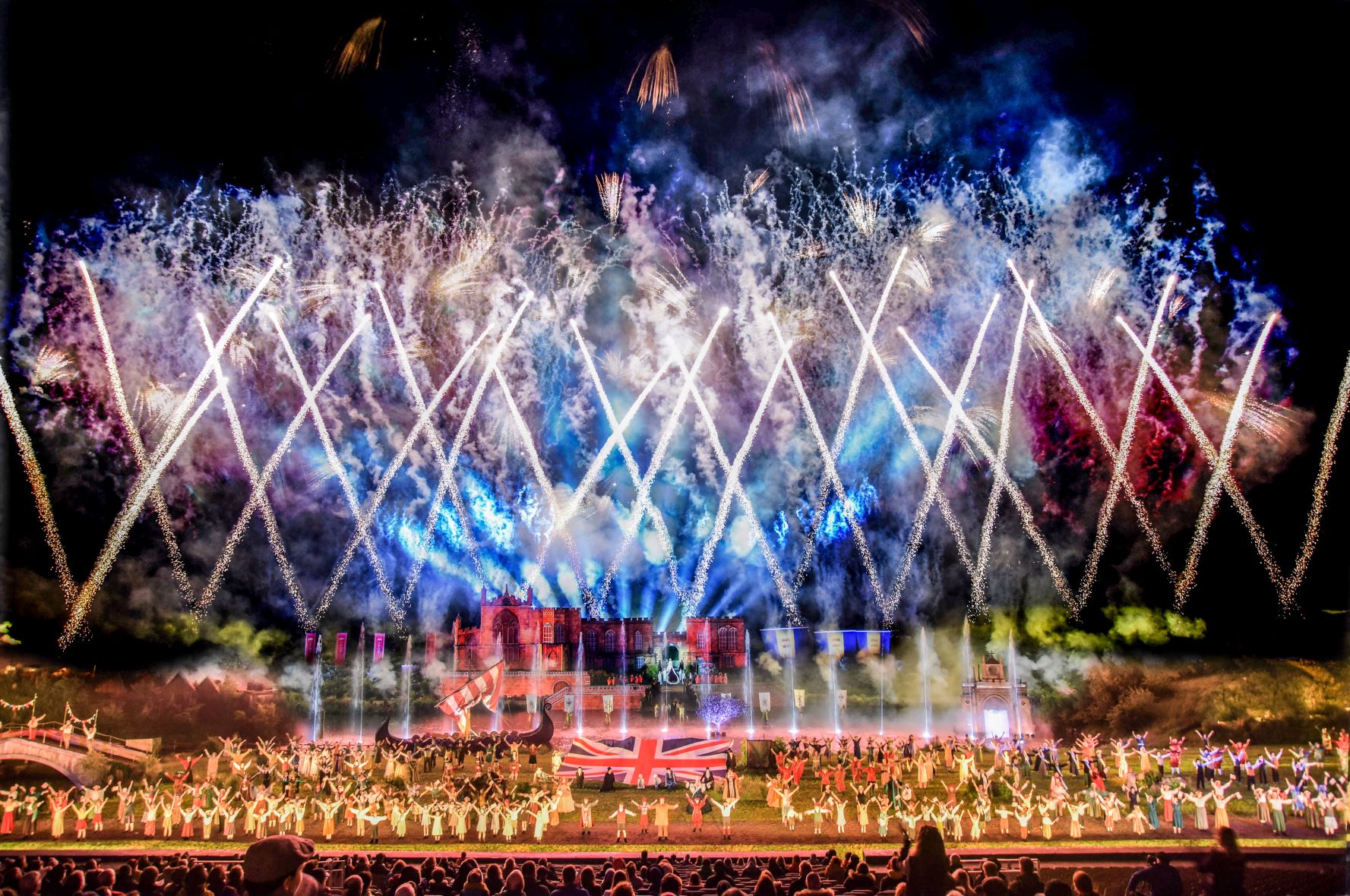
WICKED CELEBRATES ITS 20TH ANNIVERSARY IN THE WEST END WITH A WEEKEND OF CELEBRATIONS ANNIVERSARY…

Tourism Alliance Weekly Update – 4 June 2026
In this newsletter:
• Submit Your News
• PARLIAMENTARY & POLITICAL
• TA NEWS
• INDUSTRY INTELLIGENCE
• MEMBER EVENTS
• FORWARD LOOK
From Eddy Leviten, Executive Director
This week the visitor economy made the national news on BBC Breakfast, in the pages of The House magazine, in Westminster Hall, and on the front pages of the trade press. The reasons are both exciting and sobering.
The exciting: today I was in York for BBC Breakfast, making the case for the visitor economy as an economic powerhouse (£147 billion GDP, 2.4 million jobs, every region and constituency). Yesterday, there was the ground-breaking ceremony for Universal United Kingdom Resort – a £6 billion investment in a new theme park in Bedfordshire, expected to open in 2031 and bring over a million additional overseas visitors annually.
The sobering: the Tourism Minister confirmed in The House magazine that the Overnight Visitor Levy Bill is proceeding, while a Westminster Hall debate on coastal and seasonal hospitality businesses laid bare exactly what is at stake for communities that depend on tourism. Joe Robertson MP put it plainly: the Government has been “careless” about how its tax policies have fallen on coastal communities. A Labour MP, Emma Lewell (South Shields), told the same magazine that a visitor levy “will absolutely kill the local economy” in areas like hers.
We need a Government that believes in our sector, yet we have a Government proceeding with a levy it has never modelled. The TA’s job is to press hard to get action. That is what we are doing in Parliament, with Ministers, and through the APPG Hospitality and Tourism inquiry and CMS Select Committee Inquiry.
On VAT: we called again this week for a permanent 10% VAT rate for the visitor economy to make us competitive with European neighbours. The Government has now put the full-reduction cost on the parliamentary record — £17 billion for a cut to 5%. A cut to 10% would cost much less and deliver long-term benefits. That is the argument we will be making to HM Treasury.
Submit Your News
Do you have news, events or announcements relevant to the visitor economy? Members are welcome to submit items for inclusion in future editions. Please send submissions to mandy.belnick@tourismalliance.com.
PARLIAMENTARY & POLITICAL
Westminster Hall Debate: Seasonal Hospitality Businesses in Coastal Areas (3 June 2026)
Joe Robertson MP (Con, Isle of Wight East) secured a Westminster Hall debate on Government support for seasonal hospitality businesses in coastal areas on 3 June 2026. The overnight visitor levy, coastal tourism and hospitality taxation were all central themes, with eight keyword mentions of “visitor economy” and four of “overnight visitor levy” recorded in the session.
Robertson challenged the Government directly, stating he did not accuse Ministers of intending to make life harder for coastal tourism businesses, “but I do hold them responsible for being careless about how their policies, in particular taxation, have fallen on communities such as mine. It is time for the Government to recognise that and make amends.” He named local Isle of Wight businesses — the Wildheart Animal Sanctuary, the Point in Bembridge, Braai in Brading and the Sandown Boulevard street food market — as examples of the innovation and regeneration under threat.
Adam Dance MP (LD, Yeovil) intervened to ask whether Robertson shared his concern that a tourism tax would cause their areas to “really suffer.” Ben Maguire MP (LD, North Cornwall) also contributed. The debate covered business rates, VAT and the visitor levy as compounding cost pressures on seasonal businesses.
Sources: Seasonal Hospitality Businesses in Coastal Areas – Hansard – UK Parliament | whatson.parliament.uk
Tourism Minister Interview: The House Magazine (2 June 2026)
Stephanie Peacock MP gave a wide-ranging interview to The House magazine, covering the OVL, the short-term lets registration scheme, coastal tourism, and the new domestic tourism campaign.
OVL: Peacock acknowledged the “mixed reaction” to the levy. On ring-fencing: “I think there’s a really strong argument for ring-fencing money for tourism, but the whole point of giving it to mayors is for them to make that decision.” On consistency: variation between mayoral areas “will potentially present a challenge for a big national company” — “we haven’t made the decisions on that.” On London: “London is going to do well out of it because it has the most visitors — that’s inescapable.”
New domestic tourism campaign: Peacock announced the first national domestic tourism campaign since Covid, starting June 2026. Government spending of £1.2 million (target £2m with private investment). Phase 1 promotes coastal destinations — Whitby, Yorkshire, Blackpool, Devon and Cornwall. Phase 2 (autumn) becomes place-specific. Online influencers and local print media to be used.
STR registration scheme: delayed from April — now expected later in 2026, mandatory from April 2027. First ministerial commitment to take action on platform-hopping enforcement: “We are going to take action on it.”
Note: MHCLG, not DCMS, is the lead department on the OVL Bill. Members engaging on levy design should direct representations to MHCLG.
Sources: The House — Stephanie Peacock interview, 2 June 2026 | The House — Tourist Tax: How Will It Work?, 3 June 2026
OVL: The Political and Policy Picture
Two in-depth articles in The House this week provide the most comprehensive political analysis of the OVL Bill yet published.
Why Government changed its mind: Steve Rotheram (Liverpool City Region Mayor) reveals Chancellor Reeves was initially concerned revenues would simply plug local government funding gaps. Mayors had to provide concrete examples of economic growth impact. Decisive conversations were with James Murray MP, then Chief Secretary to the Treasury.
Flat fee vs percentage: Government favours a percentage model; several mayors prefer a flat fee. Kim McGuinness (North East) plans a £2 per night flat charge (~£20m/year). Oliver Coppard (South Yorkshire) also backs the flat fee. Andy Burnham says mayors should decide. Chris Webb MP urges uniformity: “that’s what I’m hearing from the sector.”
Labour opposition: Emma Lewell MP (South Shields): “will absolutely kill the local economy” in seaside towns. “There’s no massive clamour of MPs asking for it, the public don’t want it, it wasn’t in our manifesto.”
Oxford Economics (commissioned by UKHospitality): a 5% charge across England could cause up to 33,000 job losses by 2030. An MRP poll shows majority opposition in 574 of Great Britain’s 632 parliamentary seats.
No economic modelling: the Treasury answered three further WQs from Alison Griffiths MP on OVL impacts on SMEs, employment, domestic tourism and coastal visitor numbers. All three received identical boilerplate with no economic assessment. This is now the sixth occasion on which the Treasury has declined to publish any OVL economic modelling. Joe Robertson MP’s WQ on overseas tourism (3548) and Rebecca Smith MP’s three-limbed question (4740) remain unanswered.
Sources: The House — Tourist Tax: How Will It Work?, 3 June | Written questions and answers – Written questions, answers and statements – UK Parliament
APPG Hospitality and Tourism: Visitor Levy Inquiry Sessions
The APPG for Hospitality and Tourism, chaired by Chris Webb MP, is conducting a formal inquiry into the visitor levy. A first session was held on 20 May. Two further sessions are confirmed:
• Tuesday 9 June, 2pm–3pm, Room T, Portcullis House — Impact across the wider visitor economy. Panellists: David Pugh (Merlin Entertainments), Joss Croft (UKinbound), Andrew Clarke (Business Travel Association), Kate Shane (Blackpool Tourism), Lauren Goodwin (Greene King).
• Tuesday 23 June, 3pm–4pm, Room N, Portcullis House — Panellists: Cllr Julie Jones-Evans (LGA), Tobias Warnecke (German Hotel Association), Ben Spier (Sykes Holiday Cottages), Kate Nicholls OBE (UKHospitality).
The APPG inquiry runs in parallel with the CMS Select Committee’s tourism inquiry. Members wishing to submit written evidence should contact the secretariat at UKHospitality.
Sources: UKHospitality — APPG Visitor Levy Inquiry
VAT: £17bn Cost Figure on the Record and the 10% Case
The Treasury has placed a significant figure on the parliamentary record. Answering Andrew Snowden MP (Con, Fylde), Dan Tomlinson MP confirmed that HMRC estimates the cost of reducing the standard VAT rate on all accommodation, food and beverage from 20% to 5% would be £17 billion in 2026–27. The Lords received the same line from Lord Livermore (HMT): the 20% rate is “close to the OECD average of 19.3%” — a comparison the TA regards as misleading, since the relevant comparators are European tourism competitors: France 10%, Spain 10%, Italy 10%, Germany 7%.
The TA is calling for a permanent 10% rate, not 5%. A cut to 10% would cost substantially less than £17 billion and bring the UK into line with its main competitors. The VAT’s the Problem campaign — supported by UKHospitality, the British Beer and Pub Association and other major hospitality groups — is pressing this case publicly.
Sources: Hansard — WQ 3978, Dan Tomlinson, 3 June 2026 | VAT’s the Problem campaign
Sporting Events Bill — Lords Second Reading (3 June 2026)
The Sporting Events Bill had its Lords Second Reading on 3 June. Liberal Democrat Lords spokespersons called for the Bill’s framework to address visitor facilities, accommodation and appropriate pricing for spectators — “to drive opportunities to boost the tourist economy.” The Glasgow Commonwealth Games in July 2026 was cited as an immediate example. The Bill now enters Lords Committee stage.
Sources: Sporting Events Bill [HL] – Hansard – UK Parliament
Fiscal Devolution Roadmap — OVL in Broader Context
A written answer on 1 June from Nesil Caliskan MP (MHCLG, Minister for Local Government) confirmed the Government is developing a Fiscal Devolution Roadmap, to be published at the Autumn Budget 2026. The OVL is explicitly listed as one of the Government’s “local revenue-raising flexibilities” alongside the mayoral precept extension. This confirms the OVL is one component of a broader fiscal devolution agenda — not a standalone tourism policy. The TA’s ring-fencing ask is more pressing in this context.
Sources: Written questions and answers – Written questions, answers and statements – UK Parliament
PMB Ballot — Visitor Economy Implications
Two balloted MPs from the 21 May PMB draw are of direct relevance to the visitor economy. Steff Aquarone MP (LD, North Norfolk) is expected to table a Holiday Let Registration and Guest Safety Bill — a mandatory national STR registration scheme. Damian Hinds MP (Con, East Hampshire) — Vice Chair of the Hospitality and Tourism APPG and former hospitality professional — is also balloted, with predicted education-focused bills. First Reading: 17 June 2026. The TA is reviewing the full ballot list and will engage with relevant MPs.
Joint Letter: TA and UKEVENTS Write to Secretary of State on Loss of VisitBritain BEGP
On 3 June, the Tourism Alliance and UKEVENTS — with 18 co-signatory member organisations — wrote to Rt Hon Lisa Nandy MP, Secretary of State for Culture, Media and Sport, calling for the urgent restoration of ringfenced funding for VisitBritain’s Business Events Growth Programme (BEGP).
VisitBritain has confirmed there is no longer any ringfenced funding for Business Events or the BEGP. The team has been restructured into a slimmed-down England-only function, losing the national cross-Britain coordination role. This is a direct consequence of Government funding reductions forcing cuts of around 10% to VisitBritain’s salary budget. The responsibility lies with Government.
The BEGP’s record is compelling:
• 35:1 return on investment; £60.6 million in direct economic return since 2018 from under £1.8 million total Government investment
• Post-pandemic acceleration: direct economic return more than doubled, from £16.5m (2018–20) to £39.8m (2022–24)
• Supported events grew from 8 (2018/19) to 40 (2025/26); 167 events across 18 cities, 76 in the last two years alone
• Regional reach beyond London: Birmingham, Leeds, Glasgow, Edinburgh, Sheffield, Bristol, Aberdeen, Liverpool, Manchester, Cambridge, Newport and Newcastle
• Programme cost: less than £300,000 a year on average
The pipeline now at risk includes bids with active support to 2030: the International Congress of Mathematicians in Glasgow (5,000 delegates), the World Electric Vehicle Symposium in Birmingham (11,000 delegates) and the ITS World Congress 2027 in Birmingham (16,000 delegates).
The UK is now isolated among international competitors — all of whom are moving in the opposite direction. Canada’s equivalent ICAF delivers 22:1 ROI and has just received additional $10m in Government funding. Australia’s Business Events Bid Fund has been extended to 2032. Singapore added over S$300 million to its Tourism Development Fund in 2024. Germany, the Netherlands and the UAE all maintain dedicated national business events funding.
The letter makes three asks of the Secretary of State: confirm the extent of the pipeline impact; restore ringfenced BEGP funding at a sufficient level; and meet with industry to discuss Government advocacy for UK business events as part of the forthcoming Visitor Economy Growth Strategy.
TA Annual General Meeting — 17 June 2026
The TA AGM takes place on Wednesday 17 June 2026 from 10:30, in person at BBPA, Queen Street, London (Teams option available). The Advisory Council ballot closes 8 June — results announced at the AGM. Please confirm in-person attendance with the TA team
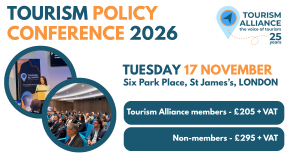
TA Policy Conference — 17 November 2026
Save the date: the TA Policy Conference takes place on Tuesday 17 November 2026 in London.
INDUSTRY INTELLIGENCE
Universal United Kingdom Resort: £6bn Investment Confirmed
On 3 June 2026, the Government and Comcast NBCUniversal confirmed one of the largest ever investments in the UK tourism sector: Universal United Kingdom Resort, to be built at Kempston Hardwick, Bedford, opening in 2031.
The investment: over £5 billion from Comcast NBCUniversal during construction; £1 billion capital investment over the first ten years; £1.3 billion from Government in infrastructure (£400m Regional Growth Fund; £438m DCMS community infrastructure grant payable on opening; £474m DfT road and rail upgrades). The resort will create 28,000 jobs, generate nearly £50 billion economic benefit by 2055, and attract over one million additional overseas visitors annually.
The announcement was made jointly by Chancellor Rachel Reeves, Culture Secretary Lisa Nandy MP and Business Secretary Peter Kyle MP. For the TA: this confirms the visitor economy’s investment credentials and directly strengthens the case for ring-fencing OVL revenue for the visitor economy infrastructure that makes such investments viable.
Sources: GOV.UK — Universal United Kingdom Resort, 3 June 2026 | universalukproject.co.uk
VisitEngland Accommodation Stock Audit: 90% of Tourism Properties Are Short-Term Rentals
VisitEngland published its England Accommodation Stock Audit on 4 June 2026 — the first since 2016. Of the estimated 334,000 properties in England’s tourism accommodation sector, 300,431 (90%) are short-term rentals. By comparison: 16,377 hotels; 12,401 B&Bs and guest houses; 5,130 camping grounds.
Key implications:
• OVL design: the levy base is overwhelmingly STR properties, not hotels. The design of collection, compliance and exemptions must reflect this reality.
• STR registration: MHCLG will need to register over 300,000 properties. Two WQs pressing for a firm date (Voaden 4732; Cooper 6498) remain unanswered.
• Business rates: hotels carry the full burden; 300,000+ STRs largely do not — a structural disparity central to the TA’s Taxation and Competitiveness working group agenda.
Local authority level data is available via the VisitBritain website.
Sources: VisitBritain — England Accommodation Stock Audit
VAT’s the Problem: Campaign for a Permanent 10% Rate
The VAT’s the Problem campaign — backed by UKHospitality, the British Beer and Pub Association and other major hospitality groups — is calling for a permanent reduced rate of VAT for the hospitality and tourism sector. The campaign directly supports the TA’s call this week for a permanent 10% VAT rate, which would bring the UK into line with France, Spain and Italy without the £17 billion cost of going to 5%. Members are encouraged to support the campaign.
Sources: VAT’s the Problem — vatstheproblem.co.uk
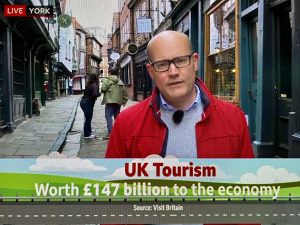
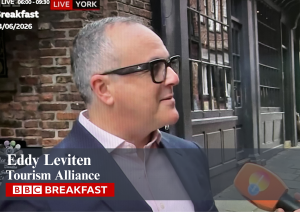
Sources: Watch the interview
Global Airline Passenger Traffic: First Post-Covid Decline (IATA, April 2026)
Global air passenger traffic declined 3.4% year-on-year in April 2026 — the first contraction since the post-Covid recovery. Middle East carriers saw demand fall 46.6% year-on-year; capacity (ASKs) fell 2.9% globally as airlines cut supply. This is the macro context for TA member polling: the Gulf hub capacity reduction explains why visitors from Australia, New Zealand, Malaysia and Japan are not arriving — not just Middle Eastern visitors directly. The TA is pressing this with Ministers.
Sources: IATA — Middle East War Leads to 3.4% Fall in Air Passenger Demand, April 2026 | IATA — Air Passenger Market Analysis, April 2026
EU Entry/Exit System (EES): Situation Continues to Deteriorate
ACI Europe, A4E and IATA have jointly warned that EES — live across all 29 Schengen countries since 10 April — continues to cause significant disruption, with queues potentially reaching four hours at peak summer traffic. Processing times have increased 70% (ACI Europe). Suspension mechanisms may not be available beyond early July. For TA members in the travel trade: consumer anxiety about EES disruption is active. For the visitor economy: the UK sits outside EES. Visitors to Britain face no biometric registration requirement — a genuine competitive differentiator that VisitBritain’s summer campaign should be actively promoting.
Sources: Travel Weekly — EES: situation deteriorating, May 2026
VAT (Reduced Rate) (Hospitality and Tourism) Order 2026 — SI Laid
The statutory instrument (SI 2026/576) giving legal effect to the Great British Summer Savings scheme was laid before Parliament on 2 June 2026. Members should note the precise legal scope:
• Children’s meals: in-restaurant only; meals “held out for sale as a meal for a child”
• Shows, exhibitions, theatre, cinema: children’s or family tickets including at least one child
• Circuses, fairs, theme parks, adventure parks, soft-play, zoos, aquariums, farm attractions, nature reserves, observation attractions, museums: all adult and child admissions
Relief applies to admissions on a date within 25 June–1 September 2026. A multi-visit ticket where the first admission falls within the period qualifies. Pure season tickets extending beyond 1 September do not qualify unless priced the same as a single-entry ticket. The TA’s two asks to the Chancellor (point-of-purchase application; support for charitable attractions) have not been incorporated in the SI as laid.

Related Posts